ALETHIC ENGINEERING · GUIDE
Proving mobile telemetry survives a restart
An empty queue is not a delivery receipt. Here is the evidence to keep when a phone goes offline, the app exits and the same event must arrive after restart.
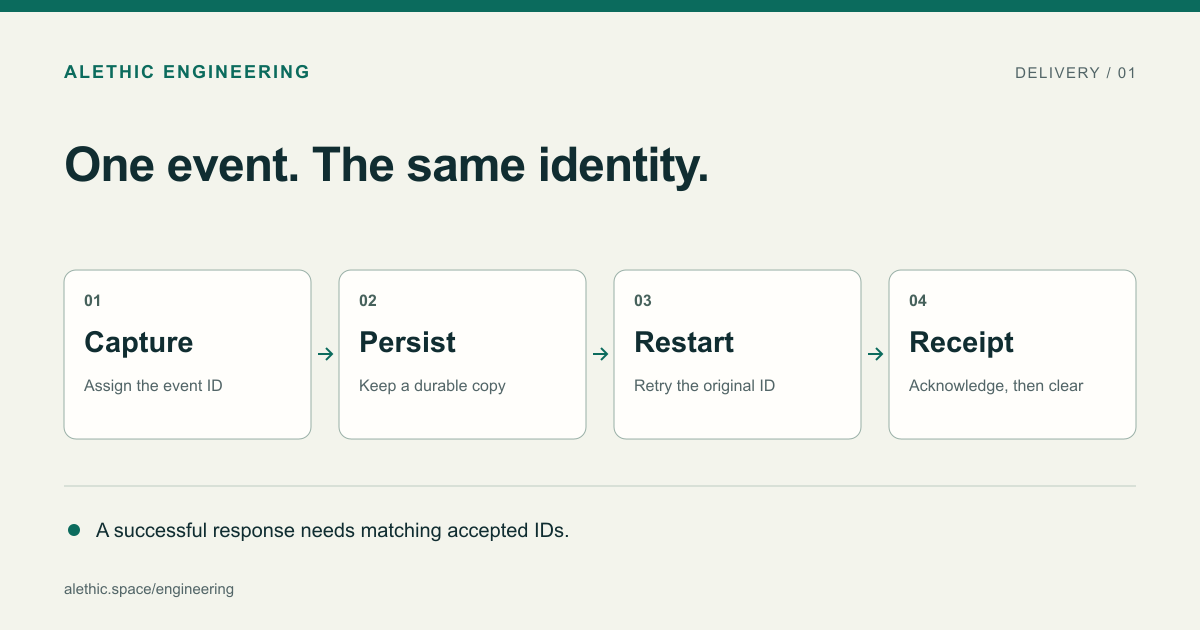
Start with one event you can identify
Give the test a single question: did this event reach the intended project without being lost during restart? Record its event ID, project, app release and capture time before testing. Use a dedicated test project and a harmless diagnostic message. A screenshot of a dashboard count cannot distinguish that event from earlier traffic.
Alethic's Flutter sender treats an HTTP 200 or 202 response as successful only when the JSON receipt identifies every event in the submitted batch. An HTTP success status with an empty body is insufficient. A response for another event is insufficient. The receipt below illustrates the shape, using a sample ID rather than a real customer event.
{
  "accepted": [
    { "id": "0123456789abcdef0123456789abcdef", "duplicate": false }
  ]
}
Make the queue durable before testing the network
Configure the SDK's persistent directory before capturing events. Its durable queue is partitioned by project credentials, so changing a project or ingestion key can change which stored queue is opened. Keep those settings stable during a restart test. Otherwise, a seemingly empty queue may simply be a different queue.
A network timeout creates an uncertain result: the collector may have accepted the request before the connection failed. Retain the original event ID when retrying. A duplicate acknowledgement is useful evidence that the collector recognizes the retry; generating a new ID would turn the same occurrence into another event.
The local spool is bounded to 50 records. It favors retaining errors over routine records when possible, but it is not unlimited storage. Inspect dropped and blocked signals alongside queued and accepted counts. An empty queue by itself cannot distinguish successful delivery from disabled collection, a cleared directory or discarded records.
Run a restart test with a written acceptance record
Use a test build on a device you control. Keep the release, key and storage directory unchanged throughout the following sequence. Save only redacted diagnostic evidence, without credentials or personal data.
- Capture a known event while network delivery is unavailable. Confirm that a durable record exists and note the queued count.
- Terminate the test app, then relaunch it using the same configuration. Confirm that the pending event is still queued before restoring delivery.
- Restore network access and let the sender retry. Record the HTTP outcome and the accepted IDs from the response body.
- Read the exact event back in the intended Alethic project. Compare its ID and release with the original record.
- Restart once more. Confirm the acknowledged record is no longer pending and inspect accepted, dropped and blocked counters together.
Keep the whole batch when the receipt is incomplete
For the current Flutter implementation, a partial receipt does not authorize deleting part of the submitted batch. The sender requires acknowledgement of all submitted IDs before completing that batch. If only one of two IDs is returned, the batch remains pending for retry. This makes the collector's duplicate handling part of the delivery contract.
Authentication, allowance and rate-limit responses require different investigation. Check the configured project and key for an authentication rejection, the workspace allowance for an entitlement rejection, and the retry interval for throttling. Do not respond to a blocked sender by repeatedly creating new events. Honor backoff and confirm the cause before resuming a test.
| Observation | What it proves |
|---|---|
| HTTP 200 with no matching IDs | The request received a response; delivery is still unacknowledged. |
| Receipt contains every submitted ID | The collector acknowledged the batch. |
| Exact event read back in its project | The stored event is available in the intended project. |
| Queue empty after another restart | Cleanup survived restart; combine this with the receipt and readback. |
Test native recovery separately
A handled error that reaches the collector does not prove recovery from a fatal native crash. Native crash capture has a separate handoff: the next launch imports a pending native report into durable telemetry, preserves the original release, and acknowledges that native report only after the durable import succeeds.
Run any intentional fatal crash in an isolated test build, then verify the recovered event after relaunch. Keep that result separate from the offline-delivery test. Symbol resolution is a further check: an event can arrive successfully while its native frames still lack the exact debug artifacts needed to resolve them.